
Plasmalogens are fats that help form cell membranes. Every time a cell releases a packet of cargo, two membranes must bend until they can join. The fats that make up those surfaces influence how readily that happens. In nerves, the same family of fats is abundant in myelin, the membrane that wraps around nerve fibers. These are two reasons scientists study plasmalogens. A third comes from human blood samples, where researchers can measure these molecules and ask how their levels relate to health.
What makes plasmalogens different from other fats?
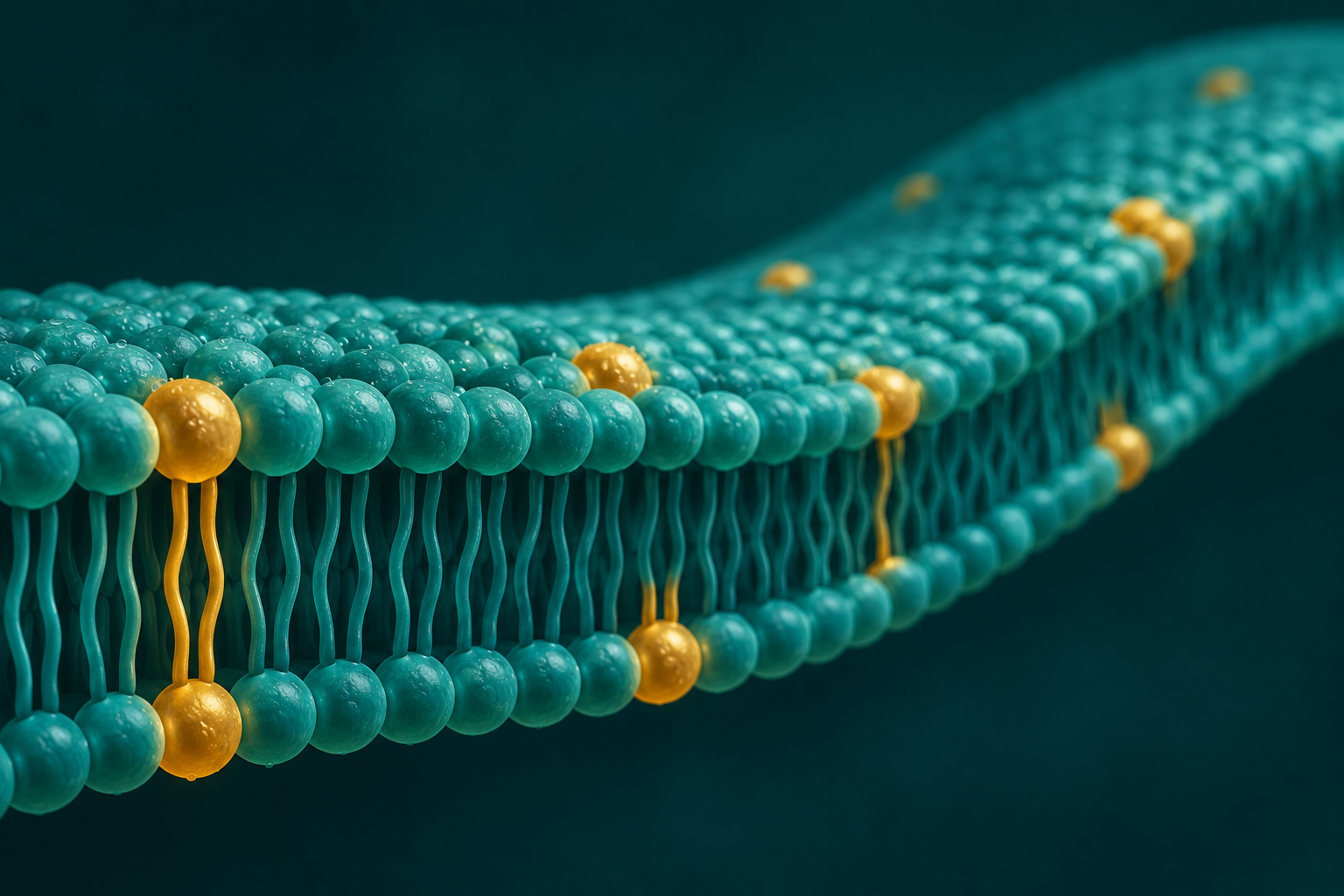
Picture a slice through a cell membrane. Its surface touches water on both sides. Inside sit two rows of fatty tails, tucked away from the water. The heads of the molecules face outward. This arrangement forms a thin boundary that can curve around something as small as a packet of chemical messengers or as long as a nerve fiber.
Plasmalogens belong to a family called phospholipids. Each has a head containing phosphate and two tails attached to a small backbone. What distinguishes plasmalogens is how the first tail attaches. The connection, called a vinyl ether bond, has an oxygen atom next to a double bond between two carbon atoms. Change that small stretch of chemistry and you change how neighboring molecules can pack together.
The name plasmalogens covers many molecules. Two plasmalogens can share that bond while carrying different fatty acids in the second tail. They can also have different heads. Those differences matter when you read a study. Researchers who measure four members of the family have sampled only part of it.
Shown in gold, plasmalogens are specialized fats that help cell membranes bend and take shape. Original schematic, not to scale.
How plasmalogens help membranes change shape
Imagine a tiny bubble enclosed by a membrane. Biologists call it a vesicle. Inside a cell, a vesicle can carry cargo to the cell surface. To release that cargo, its membrane must merge with the outer membrane. For a moment, the molecules at the meeting point have to fit into a tight curve.
In a laboratory experiment, Glaser and Gross made vesicles with different lipid mixtures. They found that a mixture containing one type of plasmalogen fused more rapidly than a comparable mixture containing a closely related fat. Working with artificial membranes let them change the chemistry and watch the physical result. It also set a boundary on the finding. A living cell controls when and where fusion occurs, partly through proteins that the model leaves out.
Why a nerve needs layers of membrane
A nerve fiber carries an electrical signal over a distance. Along much of its length, layers of myelin provide insulation. In nerves outside the brain and spinal cord, cells called Schwann cells make those layers. Each cell has to identify a fiber, grow alongside it and wrap membrane around it many times.
Tiago Ferreira da Silva and colleagues studied mice with an inherited defect in their ability to make ether lipids, the larger family that includes plasmalogens. The Schwann cells struggled to sort developing nerve fibers and form normal myelin. The researchers also found a fault in a chemical signal that helps these cells mature. The work ties plasmalogens to a specific stage of nerve development. The animals had a severe defect from early life, so their results alone cannot explain ordinary changes that come with age.
What do plasmalogens in human blood tell us?
Mitchel Kling and colleagues measured four plasmalogens and four related fats in two groups. One group contributed 1,547 serum samples and the other contributed 112 plasma samples. Serum and plasma are both the liquid part of blood, collected in different ways. Because plasmalogens circulate alongside many other fats, the team combined measurements into scores so they could compare patterns across people.
Some scores were lower in people with Alzheimer's disease than in people with normal cognition. The exact pattern varied between groups. This was an observational study. Researchers measured differences that already existed. They did not assign people to receive plasmalogens or track the effects of a treatment.
Kling and colleagues compared lipid patterns in two groups. Original graphic based on their 2020 study.
Where Prodrome Science fits into the research
Two authors of the blood study, Dayan Goodenowe and Vijitha Senanayake, listed Prodrome Sciences Inc. as their affiliation. One detail worth looking up in their paper is the ratio of plasmalogens to related fats. A ratio can fall because the first number falls or because the second rises. That is why the methods section matters when a headline says a group had lower levels. The Prodrome Science publications collection provides a starting point for exploring related work.
For example, suppose two samples contain equal amounts of plasmalogens. If one contains twice as much of the comparison fat, its ratio will be half as large. The choice of comparison changes what the number means.
Common questions
Does the body make its own plasmalogens?
Yes. Researchers identified a gene called TMEM189 that supplies instructions for an enzyme, a protein that carries out a chemical reaction. This enzyme helps form the distinctive bond in plasmalogens. When scientists switched off the gene in cultured human cells, the cells accumulated the material used in that step, and their plasmalogen levels fell sharply.
Are plasmalogens the same as omega-3 fatty acids?
No. An omega-3 fatty acid can form one tail of a plasmalogen. The fatty acid is one part of the molecule. The complete molecule also includes the head, the backbone and the other tail. When a paper mentions omega-3 plasmalogens, the researchers have narrowed their question to molecules with a particular kind of tail. Other family members can carry different tails.
Can a blood measurement tell me what is happening in my brain?
A blood sample tells researchers about the molecules circulating at the time of collection. Brain tissue is a different sample. To interpret a blood result as a measure of a change in the brain, researchers need evidence linking those two measurements. Differences between groups also leave room for overlap between individuals.
What to take away
Plasmalogens matter because cells build with them. A vesicle that merges with a membrane and a nerve wrapped in lasting layers of myelin illustrate two very different demands on the same material. Blood studies open another line of inquiry. They let researchers ask whether the balance of these fats changes alongside human health. Learning whether a change in that balance can improve how people feel or function requires studies that measure those outcomes directly.
Sources
Glaser and Gross. Plasmenylethanolamine facilitates rapid membrane fusion. Biochemistry, 1994.
Ferreira da Silva et al.. Peripheral nervous system plasmalogens regulate Schwann cell differentiation and myelination. Journal of Clinical Investigation, 2014.
Kling et al.. Circulating ethanolamine plasmalogen indices in Alzheimer's disease: Relation to diagnosis, cognition, and CSF tau. Alzheimer's & Dementia, 2020.
Werner et al.. The TMEM189 gene encodes plasmanylethanolamine desaturase which introduces the characteristic vinyl ether double bond into plasmalogens. PNAS, 2020.